Google Ads or Meta Ads?
If you are planning to advertise your business online, this is probably one of the first questions that comes to mind.
Both platforms can help businesses generate leads, sales, website traffic and brand awareness. But they work in very different ways.
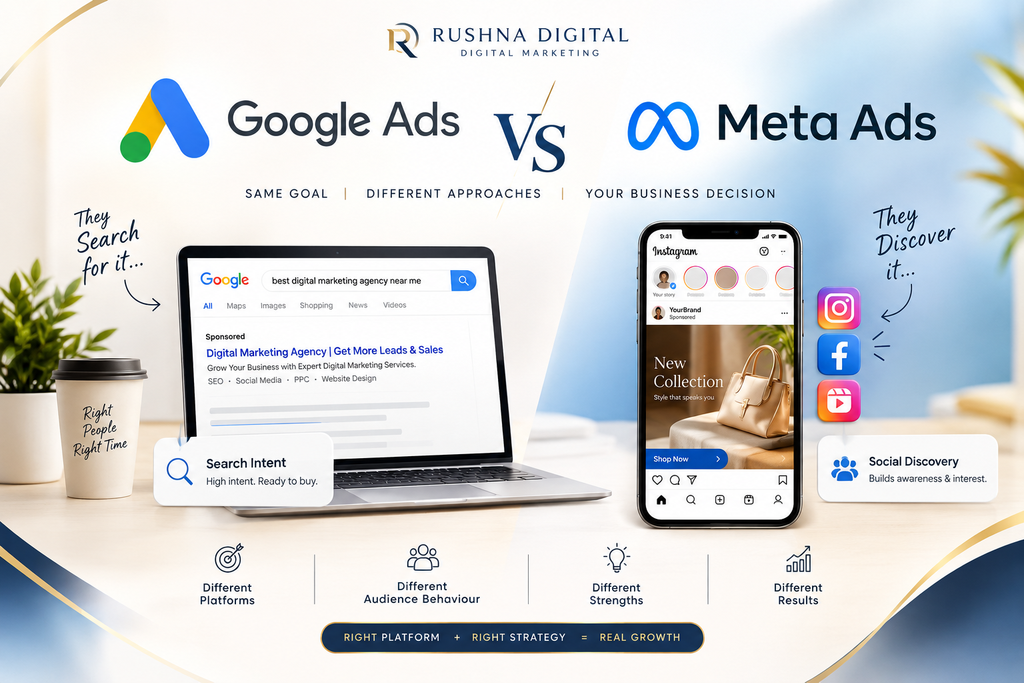
Google Ads captures existing demand. Meta Ads helps create and discover new demand.
So, the real question is not simply “Which platform is more powerful?”
It is:
“Where is my customer, and what are they doing before they buy?”
Let’s break it down.
Google Ads vs Meta Ads: The Basic Difference

Think about these two situations.
Someone searches:
“Best digital marketing agency near me”
They already have a need. They are actively looking for a service.
This is where Google Ads can be extremely useful because Search Ads can appear when people search for relevant products or services.
Now imagine someone scrolling Instagram and seeing a beautiful advertisement for a new jewellery brand.
They weren’t necessarily searching for jewellery.
But the creative catches their attention.
They become curious, visit the profile and eventually purchase.
This is where Meta Ads can be particularly useful for discovery, visual storytelling and reaching audiences based on factors such as interests and behaviour.
In simple words:
Google Ads = “I am looking for it.”
Meta Ads = “I discovered it.”
Google Ads vs Meta Ads: Complete Comparison
| Factor | Google Ads | Meta Ads |
|---|---|---|
| Main platforms | Google Search, YouTube, Maps and other Google properties | Facebook, Instagram and other Meta placements |
| User mindset | Actively searching | Browsing/discovering |
| Main strength | Capturing existing demand | Creating awareness and discovery |
| Common formats | Search, Shopping, Display, Video, Performance Max | Image, Video, Reels, Stories, Carousel |
| Targeting | Keywords, audiences, location and other signals | Audience, interests, behaviours and other targeting signals |
| Best suited for | Search-driven products and services | Visual, discovery-led products and brands |
| Creative importance | Important | Extremely important |
| Lead generation | Strong for high-intent searches | Strong when creative + targeting + offer work together |
| Brand discovery | More limited in Search | Strong |
| Purchase intent | Usually higher on relevant Search queries | Can range from awareness to purchase intent |
| Funnel role | Often strong at demand capture | Often strong at awareness and consideration |
Google also offers campaigns beyond Search, including Performance Max, YouTube and other Google surfaces, so “Google Ads” is broader than just search advertising.
Which Businesses Should Use Google Ads?
Google Ads can be particularly useful when people already search for the product or service you provide.
1. Local Service Businesses
Examples:
- Dental clinics
- Salons
- Interior designers
- Plumbers
- AC repair services
- Digital marketing agencies
- Photographers
- Lawyers
- Home renovation services
For example:
“dentist near me”
“interior designer in Delhi”
“digital marketing agency in India”
These searches show that the person already has a requirement.
2. Educational Businesses
Google Ads can be useful for:
- Coaching institutes
- Online courses
- Skill-development institutes
- Universities
- Training centres
- Certification programmes
People frequently search for specific courses, institutes and training options, making search intent valuable.
3. Real Estate
Real estate businesses can use Google Ads to reach people searching for:
- Flats for sale
- Properties in a particular city
- Commercial properties
- Apartments for rent
- Plots for sale
However, real estate campaigns generally require strong landing pages and proper lead follow-up too.
4. B2B Businesses
For many B2B companies, Google Search can help reach people actively looking for a particular solution.
For example:
“CRM software for small business”
“accounting software for business”
“IT support company”
The important factor is whether there is meaningful search demand for the solution.
Which Businesses Should Use Meta Ads?
Meta Ads can be particularly useful when visual presentation, discovery and audience targeting play an important role.
1. Fashion & Clothing Brands
Perfect examples include:
- Clothing brands
- Jewellery
- Shoes
- Bags
- Accessories
- Ethnic wear
A strong Reel, product video or carousel can introduce the product to people who weren’t actively searching for it.
2. Beauty & Skincare Brands
Meta can be useful for visually demonstrating:
- Products
- Routines
- Tutorials
- Before/after-style creative where appropriate
- Product benefits
- Customer experiences
The creative itself can become part of the marketing.
3. Food & Lifestyle Businesses
Examples include:
- Cafés
- Restaurants
- Bakeries
- Cloud kitchens
- Food brands
- Lifestyle products
Beautiful photography and short-form video can help generate discovery and engagement.
4. D2C Brands
Direct-to-consumer businesses often benefit from Meta’s visual formats.
For example:
A new candle brand
Someone may not search for that specific brand on Google.
But they may discover the brand through an Instagram Reel, see the product and become interested.
5. New & Emerging Brands
If your business is new and people don’t know your brand yet, Meta can help introduce your brand to a relevant audience through creative content.
The objective isn’t always an immediate sale.
Sometimes the first step is:
Discover → Follow → Explore → Trust → Purchase
Meta Ads vs Google Ads: Which Is More Powerful
There is no universal winner.
And this is one of the biggest mistakes businesses make.
A platform can be powerful for one business and much less useful for another.
Consider two businesses.
Business A: Emergency Plumbing Service
Someone searches:
“emergency plumber near me”
Google Ads can put the business in front of someone who is already looking for help.
Business B: New Jewellery Brand
A person may never search for that particular jewellery brand.
But a beautiful Instagram video can introduce the brand and create interest.
Meta Ads may therefore play an important discovery role.
Same advertising budget.
Different customer behaviour.
Different platform opportunity.
Industry analyses similarly distinguish Google’s intent-led search behaviour from Meta’s discovery-led social advertising, while noting that the appropriate platform depends on the business and customer journey.
A Simple Business-Type Guide
| Business | Platform to Consider | Why |
|---|---|---|
| Dentist / Clinic | Google Ads | People actively search for services |
| Plumber / Electrician | Google Ads | Strong need-based searches |
| Lawyer | Google Ads | Service is often searched directly |
| Coaching Institute | Google + Meta | Search demand + awareness |
| Real Estate | Google + Meta | Search intent + visual property promotion |
| Jewellery Brand | Meta + Google | Discovery + product searches |
| Fashion Brand | Meta + Google | Visual discovery + product intent |
| Restaurant | Google + Meta | Local searches + visual content |
| D2C Brand | Meta + Google | Discovery + purchase intent |
| B2B Software | Google + Meta | Search demand + audience nurturing |
| Digital Marketing Agency | Google + Meta | Search intent + brand building |
| New Product Category | Meta | Useful for introducing the product |
| Local Service | Customers often search when they need the service |
Important: This is a starting framework, not a fixed rule. A business should look at its audience, search demand, sales cycle, product type, geography, budget and conversion data before deciding where to invest.
Can a Business Use Both Google Ads & Meta Ads?
Absolutely.
In fact, the two platforms can complement each other.
Imagine a customer journey:
STEP 1 — DISCOVERY
The customer sees your brand on Instagram.
Meta Ads
↓
STEP 2 — INTEREST
They visit your website or Instagram profile.
↓
STEP 3 — SEARCH
Later, they search your brand or product on Google.
Google Ads
↓
STEP 4 — CONVERSION
They visit your website and make an enquiry or purchase.
This is why businesses shouldn’t always think:
Google OR Meta
Sometimes the better question is:
Google AND Meta — what job should each platform do?
The “Intent vs Discovery” Rule
If you remember only one thing from this article, remember this:
🔎 GOOGLE ADS
Customer has a problem → Customer searches → Your business appears
📱 META ADS
Customer is browsing → Your creative appears → Customer discovers your brand
That’s the fundamental difference.
5 Questions to Ask Before Choosing Your Platform
Before spending money on ads, ask:
1. Are people already searching for my product or service?
Yes → Google may be important.
2. Is my product highly visual?
Yes → Meta may be particularly useful.
3. Is my business new?
You may need awareness and discovery before expecting large volumes of branded searches.
4. Is my customer ready to buy immediately?
If customers typically search when they need your service, Google Search may be valuable.
5. Does my product need explanation or inspiration?
If strong visuals, videos or storytelling can create interest, Meta may be valuable.
The Biggest Mistake Businesses Make
Many businesses ask:
“Which platform has cheaper ads?”
That’s not the best question.
Instead ask:
“Which platform can reach the right customer at the right stage of their buying journey?”
A cheaper click isn’t necessarily better if it doesn’t generate a meaningful business result.
Similarly, a more expensive click isn’t automatically bad if it brings a customer who converts profitably.
Your real measurement should go beyond clicks.
Look at:
Leads → Qualified Leads → Sales → Revenue → Profit
Final Verdict: Google Ads or Meta Ads?
There isn’t one platform that is universally more powerful.
Choose Google Ads when:
✔ People actively search for what you sell
✔ Your business solves an immediate problem
✔ Search intent is strong
✔ You want to capture existing demand
✔ Your product/service has clear search queries
Consider Meta Ads when:
✔ Your product is visually attractive
✔ You need brand awareness
✔ Your audience discovers products through social media
✔ You have strong images/videos/Reels
✔ You are launching or introducing a new product
Consider BOTH when:
✔ You want discovery + demand capture
✔ You have enough budget and resources to manage both properly
✔ Your customer journey happens across multiple channels
✔ You want to build awareness while capturing people who are ready to buy
One-Line Takeaway
Google Ads helps you reach people who are looking.
Meta Ads helps you reach people who may discover, explore and become interested.
The smartest advertising strategy isn’t about choosing the platform that sounds more powerful.
It’s about choosing the platform that matches your customer’s behaviour.
Ready to Advertise Smarter?
At Rushna Digital, we believe digital advertising isn’t about simply putting money behind an ad.
It’s about understanding:
Your Audience + Your Goal + Your Customer Journey + The Right Platform
Because the right ad, shown to the right person, at the right moment can make all the difference.
Rushna Digital — Turning Digital Marketing Into Meaningful Growth.