Introduction
The digital world is changing rapidly, and the way people search for information is changing with it. Earlier, people mainly used traditional search engines like Google to find answers to their questions. Today, many users are also turning to AI-powered tools such as ChatGPT, Google AI search features, and other generative AI platforms for information, recommendations, and solutions.
This change has introduced a new concept in digital marketing called GEO – Generative Engine Optimization.
GEO is becoming an important topic for businesses, website owners, bloggers, and digital marketers who want their content to be discovered through AI-generated answers.
In this blog, we will understand what GEO is, how it works, why it matters, and how beginners can use GEO strategies to improve their online presence.
What Is GEO (Generative Engine Optimization)?
GEO stands for Generative Engine Optimization.
It is the process of creating and optimizing online content so that AI-powered search engines and generative AI tools can better understand, use, and potentially mention that content in their answers.
Traditional SEO focuses mainly on improving a website’s visibility in search engine results pages (SERPs). GEO focuses on making content useful and understandable for AI-generated responses.
For example, imagine a user asks an AI tool:
“What are the best digital marketing strategies for beginners?”
The AI may generate an answer using information from different websites and sources. If your website contains clear, useful, and trustworthy information, your content may have an opportunity to be considered by the AI system.
However, appearing in AI-generated answers is not guaranteed. AI tools use different systems to select and generate information.
Difference Between SEO and GEO
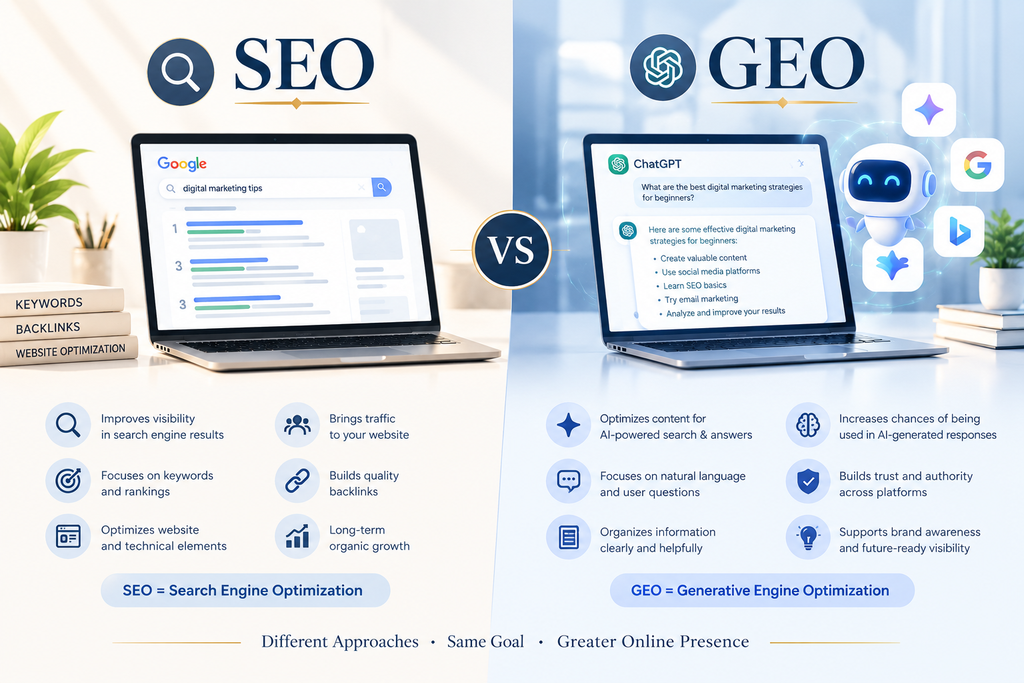
SEO and GEO are closely related, but they have different goals.
1. SEO – Search Engine Optimization
SEO is the practice of improving a website so that it can rank better in traditional search engine results.
For example:
- Optimizing website content
- Using relevant keywords
- Improving website speed
- Creating helpful blog posts
- Building quality backlinks
- Improving user experience
The main goal of SEO is to attract visitors from search engines.
2. GEO – Generative Engine Optimization
GEO focuses on preparing content for AI-powered search and answer systems.
For example:
- Writing clear and informative content
- Answering users’ questions directly
- Organizing information with useful headings
- Supporting claims with reliable sources
- Providing accurate and relevant information
The goal is to improve the chances that AI systems can understand and use your content in generated answers.
SEO helps people discover your website through search results, while GEO focuses on making your content useful and understandable for AI-generated answers.
Why Is GEO Important in Digital Marketing?
The way people search online is evolving. Instead of visiting multiple websites to find information, users may ask AI tools to summarize a topic, compare options, or recommend solutions.
This creates new opportunities for businesses and content creators.
1. Changing Search Behavior
AI-powered search allows users to ask questions in a conversational way.
For example:
“Explain digital marketing to a beginner.”
“Which marketing platform is best for a small business?”
“Give me ideas for Instagram content.”
Businesses need to create content that answers these types of questions clearly.
2. Better Content Visibility Opportunities
When AI systems use online sources to generate answers, useful website content may be considered as a source.
A well-written article can help establish your website as a relevant resource. However, GEO does not guarantee that an AI tool will cite or recommend your website.
3. Building Brand Awareness
If your business information is accurate, helpful, and available across relevant online platforms, people may become more familiar with your brand.
For example, a digital marketing website that regularly publishes useful blogs about SEO, social media marketing, and content marketing can build a stronger online presence.
4. Preparing for the Future of Search
Digital marketing continues to evolve. Learning both SEO and GEO can help beginners understand how traditional search and AI-powered search are developing.
GEO is not a replacement for SEO. Both can work together as part of a broader content marketing strategy.
How Does GEO Work?
GEO involves making content easier for AI systems to understand and use.
Here is a simple example.
Suppose you publish a blog titled:
“What Is Digital Marketing? A Beginner’s Guide”
Your blog explains:
- The meaning of digital marketing
- Different types of digital marketing
- Benefits of digital marketing
- Examples of digital marketing
- Common beginner mistakes
When an AI-powered search system processes your content, clear organization and useful information may help it understand the topic.
A simplified GEO process looks like this:
Create Helpful Content → Organize Information Clearly → Build Trust → Make Content Discoverable → Improve Based on Results
AI systems do not all work in the same way. Their selection and citation processes can vary, so no single technique guarantees visibility.
Many AI-generated searches are based on questions.
Try to answer common questions directly in your blog.
For example:
Question: What is SEO?
SEO stands for Search Engine Optimization. It is the process of improving a website to help it appear more prominently in relevant search engine results.
Clear answers help readers understand your content quickly and make the topic easier to follow.
3. Use Proper Headings.
Organize your blog with clear headings.
A good structure may include:
- Introduction
- What is GEO?
- Difference between SEO and GEO
- Benefits of GEO
- GEO strategies
- Common mistakes
- Conclusion
A well-structured article is easier for both readers and automated systems to navigate.
4. Use Relevant Keywords Naturally
Keywords are still important for SEO and can help clarify the topic of your content.
For a GEO blog, relevant keywords might include:
- Generative Engine Optimization
- GEO in digital marketing
- AI search optimization
- Generative AI search
- SEO vs GEO
Use keywords naturally in headings and paragraphs. Avoid keyword stuffing because it can make content difficult to read.
5. Add Reliable Information and Sources
Trustworthy content is important.
When writing about digital marketing, use accurate information and support important claims with reliable sources when appropriate.
For example, you can refer to official documentation, recognized industry resources, or reputable research.
Avoid publishing unsupported statistics or misleading claims.
6. Keep Your Website Information Updated
Digital marketing trends change quickly.
Review your blogs regularly and update outdated information.
For example, if you publish a blog about AI tools, make sure the features and examples are still accurate when you update the article.
7. Improve Website User Experience
A good website should be easy to use.
Focus on:
- Mobile-friendly design
- Fast loading pages
- Easy navigation
- Readable fonts
- Clear headings
- Helpful internal links
- Secure website connection
A positive user experience supports your overall website quality and traditional SEO efforts.
8. Build Your Brand’s Online Presence
Publish useful content consistently and maintain accurate business information across relevant online platforms.
For a digital marketing brand, this may include:
- Website blogs
- Instagram content
- LinkedIn posts
- Business profile information
- Educational resources
Consistency can help your audience recognize and trust your brand.
GEO Best Practices for Website Blogs
Here are some useful practices to follow when writing blogs for GEO.
Use a clear title: Make sure the title explains the main topic.
Write a useful introduction: Tell readers what they will learn.
Include direct answers: Answer important questions without unnecessary confusion.
Use short paragraphs: Make content easier to read.
Add examples: Practical examples help beginners understand concepts.
Use relevant internal links: Link to other useful blogs on your website.
Maintain accuracy: Review facts before publishing.
Avoid unnecessary repetition: Focus on quality rather than simply making the blog longer.
Common GEO Mistakes to Avoid
Many beginners make mistakes while trying to optimize content for AI search.
1. Keyword Stuffing
Repeating the same keyword too many times can make content unnatural.
Instead, use relevant terms naturally.
2. Copying Content From Other Websites
Copying content does not create unique value for your audience.
Write original explanations and add your own useful examples.
3. Writing Only for AI
Your content should be helpful to real people first.
Avoid making blogs confusing or unnatural just to appear optimized for AI.
4. Publishing False Information
Incorrect facts can reduce the quality and trustworthiness of your website.
Always check important information before publishing.
5. Ignoring Traditional SEO
GEO should not replace SEO.
Technical SEO, useful content, website performance, and search visibility remain important parts of a strong digital marketing strategy.
6. Believing Every GEO Trick
There is no guaranteed method that makes a website appear in every AI-generated answer.
Be careful of claims promising guaranteed AI citations or instant results.
How Can Businesses Use GEO?
Businesses can use GEO as part of their content marketing and online visibility strategy.
For example, a digital marketing agency can publish blogs on:
- What is social media marketing?
- How does SEO work?
- Best digital marketing strategies for small businesses
- How to create a content marketing plan
- Benefits of Google Ads
- How to improve Instagram engagement
These blogs can answer common customer questions and demonstrate the business’s knowledge.
A business that consistently publishes useful information may build a stronger relationship with its audience.
GEO and the Future of Digital Marketing
The future of digital marketing is becoming more focused on helpful content, user experience, and AI-powered search.
As more people use AI tools to find information, businesses may need to think beyond traditional search rankings.
GEO encourages marketers to create content that is:
- Useful
- Clear
- Accurate
- Relevant
- Easy to understand
- Trustworthy
However, AI search is still evolving. Search engines and AI platforms may change how they discover, select, summarize, and cite information.
For this reason, digital marketers should continue learning about SEO, content marketing, AI search, and user behavior.
Frequently Asked Questions About GEO
What does GEO stand for in digital marketing?
GEO stands for Generative Engine Optimization. It focuses on optimizing content for AI-powered search and generative answer systems.
Is GEO the same as SEO?
No. SEO focuses on traditional search engine visibility, while GEO focuses on helping AI systems understand and potentially use website content in generated answers. Both are related and can work together.
Is GEO important for beginners?
Yes. Learning GEO can help beginners understand the changing search landscape and create better content for their websites.
Does GEO guarantee that my website will appear in ChatGPT answers?
No. GEO cannot guarantee visibility, mentions, or citations in ChatGPT or any other AI platform.
Can GEO help small businesses?
GEO can be part of a small business’s content marketing strategy. Publishing useful answers to customer questions can support brand awareness and online visibility.
Should I focus on GEO or SEO first?
For most beginners, start with the basics of SEO and helpful content creation. Then learn how GEO relates to AI-powered search. A combined approach is useful.
Conclusion
Generative Engine Optimization, or GEO, is an emerging area of digital marketing that focuses on making website content easier for AI-powered search and answer systems to understand and potentially use.
As online search continues to evolve, businesses and content creators should focus on producing high-quality, useful, and trustworthy information.
GEO is not about replacing SEO. It is about adapting to new ways people discover information online.
If you are a beginner in digital marketing, now is a great time to learn about SEO, GEO, content marketing, and AI-powered search.
Keep learning, keep creating, and keep improving your digital presence.
About Rushna digital
Rushna digital – Digital Marketing is focused on learning, sharing, and exploring the world of digital marketing. From SEO and social media marketing to content creation and AI-powered search, our goal is to provide useful information for beginners and growing businesses.
Stay connected with Rushna digital for more digital marketing tips, guides, and educational blogs.