Apple and Samsung are not simply competing to sell smartphones—they are competing for attention, loyalty, and space in consumers’ minds.
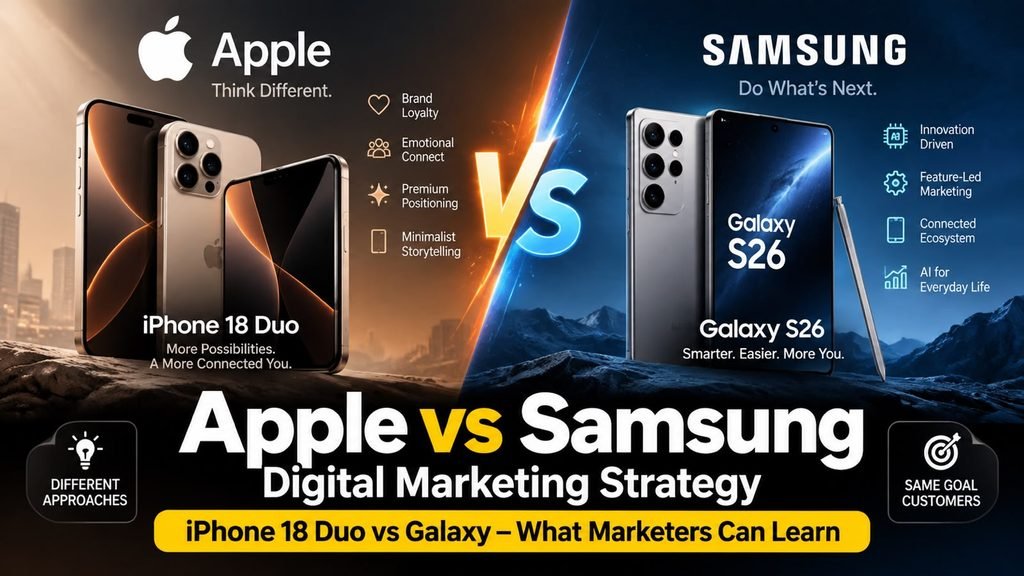
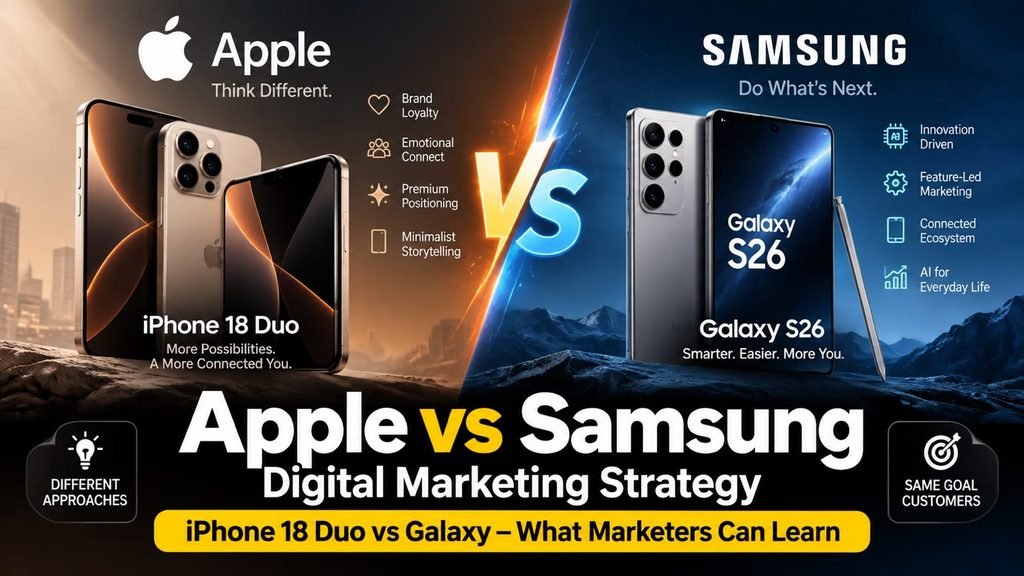
Their marketing strategies show two very different approaches. Apple typically focuses on premium positioning, simplicity, storytelling, design, and emotional appeal, while Samsung often emphasizes innovation, features, AI, comparison, and everyday usefulness.
With Apple introducing its new iPhone lineup and continuing to build anticipation around the iPhone Duo, while Samsung pushes its Galaxy ecosystem and AI-focused experiences, the competition provides an excellent case study for digital marketers. Apple currently highlights the iPhone 18 Pro and Pro Max around camera, battery, performance, and AI, while Samsung positions Galaxy around proactive AI and connected experiences.
So, what can businesses learn from these two marketing giants?
⸻
- Apple Sells an Experience, Not Just a Product
One of Apple’s biggest marketing strengths is its ability to make a technical product feel like a lifestyle choice.
Instead of overwhelming customers with specifications, Apple often presents features through simple benefits and visual storytelling.
For example, Apple’s iPhone 18 Pro messaging focuses on areas such as:
- Advanced camera capabilities
- Battery life
- Performance
- AI
- Creative control
- Premium design
The company describes the iPhone 18 Pro as a tool for creators and professionals rather than simply listing technical specifications.
Marketing lesson:
Don’t just sell what your product does. Sell what your customer can do with it.
A digital marketing agency, for example, should not simply advertise:
“We provide SEO and social media services.”
Instead:
“Turn your online presence into a consistent source of qualified leads.”
The second message sells the outcome, not the service.
⸻
- Samsung Makes Innovation the Hero
Samsung takes a different approach.
Its Galaxy marketing frequently puts technology and innovation at the center of the conversation.
The Galaxy S26 series, for example, is strongly positioned around Galaxy AI, including features designed to make everyday tasks easier and more proactive. Samsung’s messaging emphasizes AI that can understand context and reduce the number of steps users need to take.
Samsung also promotes its broader ecosystem rather than focusing only on the smartphone.
Its marketing connects smartphones with other devices and services, reinforcing the idea of a connected technology ecosystem.
Marketing lesson:
Innovation can become your marketing story.
If your company has a genuinely useful new feature, don’t hide it inside a long list of specifications. Build your campaign around the innovation itself.
⸻
- Apple Creates Desire Through Simplicity
Apple’s visual marketing is famously clean.
Minimal text. Strong product photography. Short messages. Clear calls to action.
This approach reduces distractions and allows the product to become the center of attention.
The iPhone 18 Pro website, for example, immediately highlights major benefits such as the 48MP Fusion Main camera with variable aperture, battery life, colors, and the A20 Pro chip.
This is a powerful lesson for digital marketers.
Instead of:
“Our company provides SEO, PPC, social media marketing, content marketing, website development and branding solutions.”
“More Visibility. More Leads. More Growth.”
Then explain the services underneath.
Simple messaging is easier to remember.
⸻
- Samsung Uses Features to Demonstrate Value
Samsung’s marketing frequently gives consumers a reason to explore the product.
Its Galaxy S26 messaging showcases features such as Photo Assist, Now Nudge, Now Brief, Bixby and AI-powered experiences.
Rather than simply saying “Galaxy has AI,” Samsung demonstrates how AI can help with specific tasks.
For marketers, this is an important distinction.
Don’t say:
“We offer AI-powered marketing.”
Say:
“Use AI to turn one long-form article into 10 social media posts, email content and short-form video scripts.”
The second message makes the benefit tangible.
⸻
- The iPhone Duo Creates a Different Marketing Opportunity
The iPhone Duo gives Apple an especially interesting opportunity because a new form factor can be marketed around versatility and lifestyle, rather than simply specifications.
Apple describes iPhone Duo around a large display and flexible use cases, positioning it as something that can be used in different ways.
This is an important digital marketing lesson:
New technology needs a new story.
When a product category changes, marketers should not simply advertise:
“We have a new product.”
They should explain:
“Here’s how this changes the way you do something.”
That is how a new feature becomes a compelling marketing proposition.
⸻
- Apple Builds Emotion, Samsung Builds Curiosity
This is one of the most interesting differences between the two brands.
Apple often focuses on:
Emotion → Lifestyle → Creativity → Brand → Product
Samsung often focuses on:
Innovation → Features → AI → Possibilities → Product
Neither approach is necessarily better.
They simply appeal to consumers differently.
For digital marketers, the lesson is to understand what motivates your audience.
If your audience buys based on emotion, identity, or lifestyle, storytelling may work best.
If your audience wants proof, functionality, and innovation, demonstrations and feature-led content may perform better.
⸻
- Product Launches Are Content Marketing Opportunities
Apple and Samsung understand that a product launch is not just a sales event.
It is a content event.
One launch can generate:
- Social media posts
- Videos
- Reels
- News coverage
- Reviews
- Comparisons
- Blog articles
- Influencer content
- Search traffic
- Email campaigns
- User-generated content
This creates a marketing ecosystem around the product.
For example, Apple’s iPhone 18 Pro launch has already generated official product pages, launch announcements, product videos, technical information and other content that can support the product journey.
Marketing lesson:
Don’t create one piece of content. Build a content ecosystem around one campaign.
⸻
- Samsung Shows the Power of Educational Marketing
Samsung’s marketing also demonstrates how educational content can support product marketing.
Instead of only telling consumers that Galaxy AI exists, Samsung explains what features such as Now Nudge and Now Brief can actually do.
This approach can be extremely effective for businesses selling complex products or services.
For example, a digital marketing agency could create:
- “What is SEO?”
- “How Google Ads work”
- “SEO vs PPC”
- “How social media ads generate leads”
- “5 mistakes businesses make with Instagram Ads”
Educational content builds familiarity before the customer is ready to buy.
⸻
- Brand Consistency Matters More Than Individual Campaigns
Apple and Samsung don’t reinvent their entire brand every time they launch a new smartphone.
Their campaigns may change, but their broader identities remain recognizable.
That’s an important lesson for smaller businesses.
Your Instagram post today, website tomorrow, advertisement next week and blog next month should still feel like they belong to the same brand.
Consistency should exist across:
Visuals + Tone + Messaging + Content + Customer Experience
⸻
- What Digital Marketers Can Learn From Apple vs Samsung
The biggest lesson isn’t to copy Apple or Samsung.
It’s to understand why their strategies work.
Apple Samsung
Premium positioning Innovation positioning
Emotional storytelling Feature-led communication
Minimalist design Information-rich messaging
Lifestyle marketing Technology marketing
Strong brand identity Strong product ecosystem
Simplicity Demonstration
Desire Curiosity
For a modern business, the ideal strategy may actually combine elements of both.
Think like Apple:
Build a memorable brand.
Think like Samsung:
Show people what your product can actually do.
Then add your own advantage:
Give customers a reason to choose you.
⸻
Conclusion
The Apple vs Samsung competition is more than a smartphone battle. It is a powerful example of how different marketing philosophies can compete for the same audience.
Apple demonstrates the power of simplicity, premium branding, storytelling and emotional connection.
Samsung demonstrates the power of innovation, product education, AI-focused communication and ecosystem marketing. Samsung’s current campaigns increasingly position AI as something integrated into everyday life rather than merely a technical feature.
For digital marketers, the key takeaway is simple:
Don’t just market your product. Build a story around it, demonstrate its value, and give your audience a reason to remember your brand.
Whether you’re launching a smartphone, software product, restaurant, e-commerce brand, or digital marketing service, the same principle applies:
Great marketing doesn’t just explain what you sell. It makes people understand why they should care.
⸻
Suggested SEO Keywords
Primary keyword: Apple vs Samsung digital marketing strategy
Secondary keywords:
- Apple marketing strategy
- Samsung marketing strategy
- iPhone 18 marketing
- iPhone Duo marketing
- Galaxy marketing strategy
- Apple vs Samsung marketing
- smartphone marketing strategy
- digital marketing lessons from Apple
- digital marketing lessons from Samsung
- Apple digital marketing strategy
Apple iPhone 18 Pro official page · Samsung Galaxy S26 official page